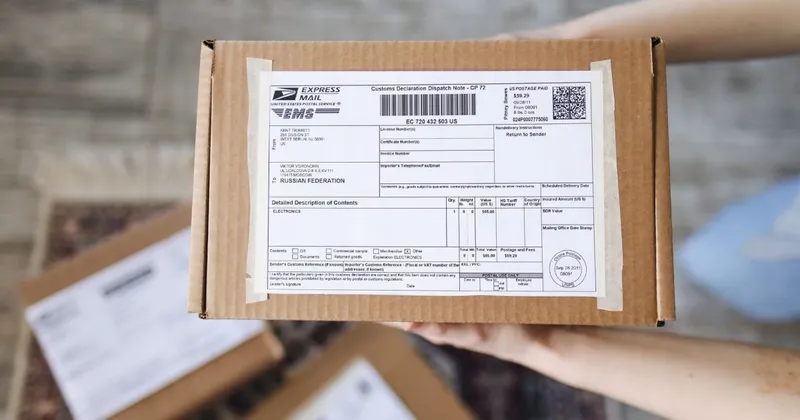
You cannot ship a parcel to the United Kingdom, Norway, Switzerland, the USA or Ukraine without a proper customs declaration. Declaring a shipment is not red tape for its own sake - it is the document the whole customs clearance relies on. Made a mistake on the declaration? The parcel stops. The recipient gets hit with extra charges, and sometimes the goods travel back. Below you will find what you must include, how to find the right HS code and why the value has to match reality.
On this page

What the declaration must include
Courier shipments usually use an electronic form plus a commercial (proforma) invoice. Whether you ship with DHL or another operator, the form needs: sender and recipient, an exact description of each item, quantity, value and currency, weight, country of origin, HS code and the purpose of the shipment (sale, gift, return).
The purpose of the shipment is not the same as the item description, although many people mix them up. If you send a gift, the declaration should say "gift", but the item description still has to be specific. Shipping goods you sold? State "sale" and add the invoice number if you have one.
Why "clothes" is not a valid description

Hundreds of parcels pass through customs every day, and vague descriptions stand out immediately. Wrote "clothes" or "gift"? That leaves the customs officer guessing: which duty rate applies, and is the item on a restricted list? Write it like this instead: not "shirts", but "men's cotton t-shirts, 2 pcs". The more detail you give, the less often the parcel gets stuck.
Shipping several different items? Describe each one separately. It is easier for the customs officer, and the recipient is less likely to face extra questions. Some countries also require the item's material, purpose or model. Requirements vary depending on what you ship and where.
How to declare a shipment: finding the HS code
The HS code (Harmonized System code) is an international product classification. The first 6 digits are the same worldwide, the EU uses an 8-digit CN (Combined Nomenclature) code, and importing countries may use longer codes. The more precise the code, the smoother clearance goes. You can find the right code by product name or description in the EU TARIC database run by the European Commission.
Not sure which code to pick? Call your carrier or ask a customs broker. A wrong HS code can lead not only to a hold but also to the wrong duty rate, which then has to be recalculated. A few minutes of searching now saves days of back-and-forth with customs later.
Value: why you cannot declare a lower amount

An inaccurate or understated value is one of the most common reasons parcels are held. Customs has the right to check the declared value and, if it does not match the market price, calculate duties on its own valuation. Deliberately declaring a lower value can lead to penalties. Always state the real value of the goods and the currency you were paid in.
A gift? The value still has to be declared - it helps customs see whether the parcel exceeds duty-free limits. The exact thresholds depend on the destination country and change over time, so check the current rules before you ship.
When shipping to Ukraine, for example, where customs rules can be stricter, an accurate value and description matter even more. Read more about shipping to Ukraine and its specifics on the SendVersal site.
For businesses: EORI number and other requirements
Shipping goods for business? You will need an EORI number. It is the EU Economic Operators Registration and Identification number, required for anyone exporting outside the EU. On top of that, the declaration must include the invoice number, and the item descriptions must match the lines on the invoice.
Business shipments often need more information too, such as the country of origin and the Incoterms. A private person sending personal belongings or gifts does not need an EORI number, but still has to follow the declaration rules.
Norway and Switzerland are not EU members but have special agreements, so declaration requirements can differ. Shipping to Norway, for example, usually requires an electronic declaration even when the value is low.
Ship outside the EU without retyping customs data
Connect your store and SendVersal fills the customs data from your order automatically. No contracts.
The most common sender mistakes
One of the most common mistakes is declaring the total parcel weight instead of the weight of each item. Customs may ask for clarification, so it is better to give each item's weight in grams or kilograms from the start. Another is the wrong currency. You bought the item in euros but entered US dollars, and now the value does not match reality. Customs starts asking why the numbers do not add up, and the parcel stops.
Another problem is a missing or inaccurate shipment purpose. Some commercial orders get declared as gifts in the hope that the recipient avoids charges. When customs checks and finds it is not a gift, the recipient pays anyway. Senders also forget the country of origin, which matters especially for goods that qualify for preferential duty rates under trade agreements.
Sometimes a sender enters the wrong HS code, thinking it does not matter. That code can mean not only a higher duty rate but extra document requirements, such as licences or certificates. Fill in the form next to the invoice, not from memory. Take your time with every field. One wrong digit can mean an extra week of waiting.
- Parcels leaving the EU need a declaration with a specific description, real value and currency, origin, purpose and HS code.
- Vague descriptions, understated values and wrong HS codes are what get parcels held or charged incorrectly.
- Before you ship, look up each item's code in the EU TARIC database and fill the form next to the invoice.
Frequently asked questions
Usually yes: most couriers ask for an HS code, and without it the declaration is often treated as incomplete. The HS code determines the duty rate and which checks are carried out. Entered the wrong code? The parcel may be held or charges calculated incorrectly, and then you have to dispute them.
Start with the EU TARIC database, where you can find the right code by product name or description. If that does not work, call your courier or ask a customs broker. They check these codes every day, and for you it is a few minutes on the phone.
No. A gift parcel also needs a declaration with a specific description, value and HS code. Mark it as a gift and enter the item's real value. Customs can compare it with the market price, and that shows whether the gift really is a gift.
Mantas runs carrier partnerships and SendVersal's own-line network to the UK and Germany. He writes about lanes, customs and what drives parcel prices.
All 5 articles by Mantas