Couriers charge for space as well as weight. A big box of pillows takes as much room in a van as a box of books. That is why every carrier compares two numbers and bills the greater one.
On this page
The formula
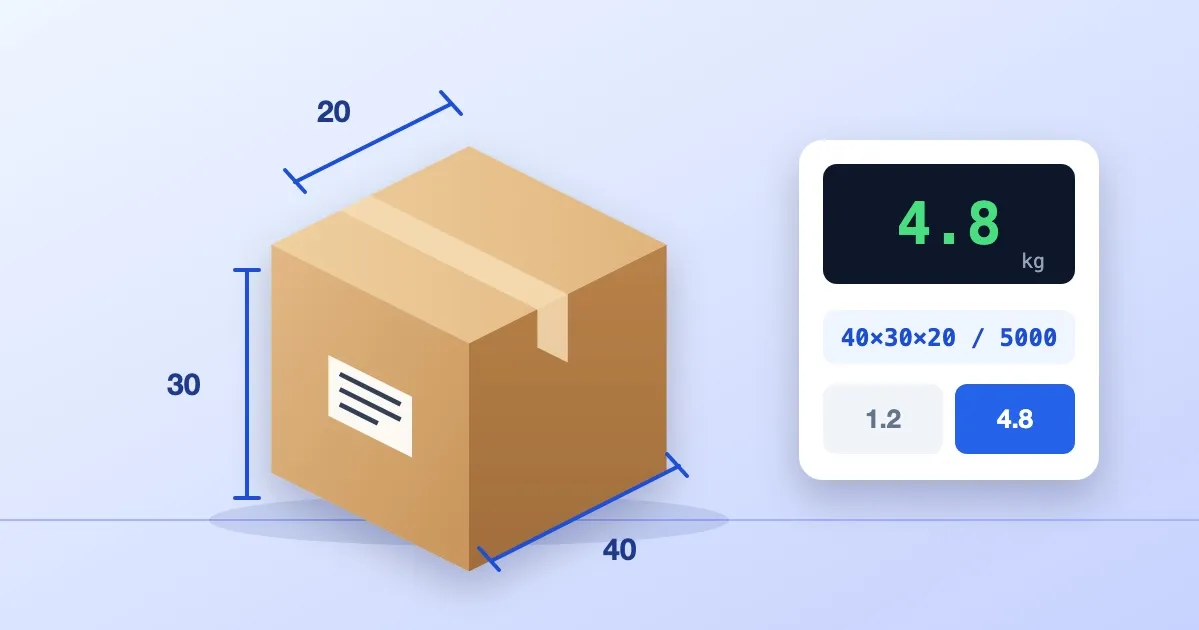
Volumetric weight is length × width × height in centimetres, divided by a divisor. The most common divisor is 5000. Some carriers and services use 4000 or 6000.
- Box
- 40 × 30 × 20 cm = 24 000 cm³
- Volumetric
- 24 000 ÷ 5000 = 4.8 kg
- Actual
- 1.2 kg
- Billed
- 4.8 kg
Why carriers do this
Vans, trucks and planes fill up by volume long before they reach their weight limit. Pricing by the greater number keeps light but bulky parcels from taking space for free.
How to pay for less air
- Use the smallest box that protects the item
- Ship soft goods like clothing in poly mailers
- Measure after packing, not before
- Keep three or four standard box sizes and save them as presets
See your billed weight before you ship
Live rates from leading couriers. No contracts.
What if the dimensions are wrong
Carriers re-measure parcels in their hubs. If the real size or weight differs from what you entered, a surcharge follows. When your data is accurate, the price you see when ordering is final.
- Couriers compare actual and volumetric weight (L × W × H in cm ÷ divisor, usually 5000) and bill the greater one.
- A 40 × 30 × 20 cm box weighing 1.2 kg is billed as 4.8 kg, so you pay for the air inside.
- Before you ship, measure after packing and use the smallest box that protects the item.